The Cost of Generalised Failure
A Trading Firm’s H2 2025 Review: Part II

Across the AXIA trading desks.
July–December 2025.
London (England) · Limassol (Cyprus) · Split & Zagreb (Croatia)
This is Part II of A Trading Firm’s H2 2025 Review. Read Part I below:
The Cost of Generalised Failure
A spectre has been haunting many desks in the past six months, and that spectre is generalised failure: the punishment for scattered engagement when opportunity fractures into islands. It names a highly unintuitive, amorphous problem—one rarely seen from a single desk. It is best seen through teams of teams: like a photonegative, it needs its positive. Naming it is halfway to dealing with it.
It goes as such: an environment of high-density opportunity—where trades come fast and regularly, supported by sustained volatility across markets—creates a relatively lower opportunity cost in being involved beyond a trader’s core competency. In effect, high-density opportunity environments are a buffet: allowing traders to sample and monetise different market phenomena, even if much of that opportunity remains half-eaten. High density lowers the cost for exploratory engagement. One can be wrong, early, clumsy—yet still learn because opportunity replenishes. The danger is that one can also perform without precision and confuse that subsidy for skill. A very directional, agitated, explosive market often experiences this phenomenon as “breakouts” from one range of prices to another. The virtuosity in skills required to trade that market, as opposed to trading breakouts in heavily compressed, low-volatility, quiet markets, are worlds apart—despite both offering “reps” and monetisation opportunities. So high density reduces the penalty for getting it wrong, because opportunities keep coming.
Used unwisely, high density becomes a false normal—rewarding this ‘general engagement’ beyond core competency—in which those inexperienced, or low skilled, could even profit from. That is, until the regime shifts and the trader discovers the bar for successfully monetising that market phenomena over time, over a series of environments and cycles is brutally higher than expected. That is what makes the trader fragile: not the loss of opportunity, but the expectations built inside abundance.
Yet in low-density environments, this relationship inverts entirely. There is a high opportunity cost in engaging in “general” or scattered trades—those that fall outside core competencies, preventing the trader from reaching a level of conviction and real size sufficient to make a meaningful difference to their trading account. Engaging in market activity this way erodes energy, focus, and P&L. The distinction matters: exploration is deliberate practice; scatter is undirected involvement. In high-density environments, scatter can masquerade as exploration. In low density, it is punished immediately.
But the biggest cost remains unseen because it is abstract: general engagement increases the chances of missing the trade at the core of that trader’s ability to monetise. In low density, the next time that core trade is viable can be far longer than expected. The risk in trying to swim between sparse opportunities is that you miss both. The distance between islands becomes too vast.
So this is generalised failure: general engagement with disparate opportunity sets—far away from each other in framework and skills required—punishes general involvement. The trader is neither specialised enough to sit on an island, nor multi-framework enough to move between them without sinking. In an environment of market islands, the age of “just get involved” is over.
Navigating the Islands
At the level of teams of teams, fragmented environments converge on two dominant solutions: the niche specialist and the multi-framework trader. We will see the former with The Voyager, who goes from general engagement to specific engagement and is rewarded for it. The latter is embodied in The Student’s ambition of developing into what we’ve formalised as the always viable trader: not being at the mercy of headlines or news-heavy environments which can dissipate as fast as they appear, and not confined to a single niche or singular framework, but wielding and combining other frameworks—market profile, the ostensibly “technical” ones—that can answer the practical questions of selection and management: what markets, when, how much, and for how long?
A singular framework of trading news headlines, by itself, also dictates when to engage with the market, eliminating the problem of “fuzzy engagement” in which new traders mostly suffer from. In other words: the vast majority of the time, the trader does nothing. This is good. But as in Part I, that singular framework can flounder in meandering, emergent volatility typical of sentiment and broad narrative-based flow—the AI overvaluation narrative, the implications of the next Fed Chair. In Q4 especially, the first headline is often faded, yet the market still does the move later. If your confirmation requires instant reaction, it keeps you out of slower-burning trades over the next few sessions. For example, following the U.S. reduction of Swiss tariffs in mid-November, the initial headlines were quickly faded to nowhere, yet the Swiss Market Index rallied considerably in the subsequent sessions as the structural risk was removed.
Returning to a trader like The Student—who has consciously chosen to direct his career towards being multi-framework—he can repurpose macro and news experience previously optimised through headline trading in H1 for thematic, sentiment-based trading in H2 by splicing it against other frameworks: market structure, correlations, profile.
For example, news and macro remain the source of the idea, but the trade itself is deployed, managed, framed, and validated through other sources of information to lean on—market profile, structure, correlations, or other market phenomena that, in this period, are consistent enough to be called patterns. A trader who recombines skills in this way can simply participate in more of the opportunity set—situations like the Swiss tariff repricing, or whatever appears next—without being trapped by the headline’s first reaction.
That is how one avoids generalised failure when opportunity fractures into islands: by repurposing existing skills, building alternative ways to interpret market behaviour and reaction, and removing “fuzzy engagement” by answering the questions a headline alone cannot.
Trading Careers Are Not Alike
Once opportunity fractures into islands, the cost is paid differently depending on where a trader is in their career. Senior, experienced traders who monetised high-density H1 2025 can afford to ride out a low-density H2. They can sit on their island, maximise the scarcer opportunities once they arrive, and push them all the way with size. One well-executed trade per month will outpace any flat or small negative periods accumulated from dud trades. But for them, the opportunity cost of distraction is enormous: getting stuck into smaller trades diverts energy, time, and resources from the core competency they could deploy with conviction. Which is why they often do indeed perform better by increasing focus through more constraints, and a more defensive approach, relative to the first six months of the year.
Yet this dynamic is insidiously reinforcing. Inactivity goes unpunished in the immediate term, which obscures the long-term danger: failing to learn, change, and adapt. As The Godfather noted in Traders of Our Time, he was among the last of his professional network still making money trading spreads while both volatility and opportunity dwindled. He saw the writing on the wall and ventured away—into loss-making outright trading—while consciously foregoing P&L he could still harvest in spreads. That proved to be among the most important decisions he had ever made: the kind that matters more than any day-to-day decision, precisely because the day-to-day can keep rewarding the wrong behaviour.
New traders do not have this luxury, nor should they. The pressure to perform—from track-record building to qualify for backing, or to draw funds because they need cashflow to pay food and rent—means they must monetise the lowest-hanging fruit currently available. But in low-density environments, that fruit is barely visible to begin with. Once they start to engage with it, it disappears just as fast and likely erodes P&L in the attempt. They try to swim from one island of opportunity to the next, but the distance is so vast they fail.
Where senior traders can be defensive—waiting—junior traders must be piranhas: constantly active, scrappy, moving to eat something from anything in the waters—not in general engagement, but in harvesting whatever low-hanging fruit sits on their shoreline. That low-hanging fruit is often identified by the team, or the extended mind of the trading floor, so these newer traders do not pay for exploratory learning where they cannot afford it. They borrow the floor’s search function, then learn by execution. They must forego maximisation, precision, and niche ownership for speed of access because, at this stage, eating something is better than nothing—and survival, the launch into minimum viable trader (MVT), comes first.
For senior traders, defensiveness is functional: they must stay fresh to push rare trades to the max; small trades that merely bump P&L are a waste of time and a huge opportunity cost. Juniors cannot be choosers: even small, low-hanging trades must be taken—and they cannot get it wrong in size, or existentially, because their ability to skew outcomes with conviction is still narrow.
This divergence reflects a deeper asymmetry in how the market punishes each cohort. Junior traders—those building or rebuilding an account—are punished strategically more by getting it wrong than by missing opportunities. A blown account or a career-ending drawdown cannot be recovered, and the size asymmetry they can deploy is not yet large enough to skew outcomes in their favour on the trades they do catch.
Senior traders face the inverse. Firmly in the “wealth-building” camp as explored in Traders, they are punished strategically more by missing the opportunity than by getting it wrong. They can bounce back from mistakes fairly quickly—their account and track record provide runway—but missing the opportunity is forever. They possess the size and conviction to make rare opportunities disproportionately valuable; failing to capitalise represents an irrecoverable cost. That rare opportunity is often one of the few chances in the year to push milestones and break boundaries. In effect: juniors must survive by activity; seniors by patience and precision in an island market.
So the new trader, or the MVT goal is survival by activity: to print green however it can be done, without taking existential risk that will one day blow them up. There is no gold medal for technique at this stage. The gold medal is simply staying in the game. They cannot push their best trades with meaningful size anyway; the asymmetry they can deploy between small and large conviction is not yet significant. So they must take what they can and squeeze out a positive P&L by the end of the day, the week, the month. The rest takes care of itself after that. No trading approach is too strange or beneath a trader at this stage. Nor, perhaps, should it ever be.
It is precisely because of this asymmetry that low-density environments of opportunity breed much sharper traders. High density and volatility create slack and imprecision simply because one can get away with it. At the low-frequency end of the spectrum—those with the confidence to deploy huge size at a moment’s notice—these periods are survivable. H2 2025 is another of its gifts: forcing traders to evaluate any slack in their game and address it before it embeds too deeply, setting them up for 2026 and forcing newer traders to learn what change actually means.
This shift from high to low density has also revealed—or shattered—those who fell into the trap of solving H1 2025. To assume this is what trading is, and that they would sail into the sunset. Even more fragile if they built expectations out of this solving: the market rewarding them with account growth, or attaching their identity to however they performed, or to whatever strategy or market approach they believed they had—only for it to be viciously dismantled later. That is when the performer has to quickly and aggressively return to being a learner. What has blocked, empirically, some traders in becoming learners once more is a performer’s ego crossed with expectations of peers and themselves. And both, if anything, are fragile within scarcity.
The Hankering For Certainty
For many newer traders, the attrition from generalised failure reveals a visceral cognitive change and cost. It is most clearly observed among newer traders, yet no one is fully free of it: it is all too human to hanker for certainty after spending too long in ambiguity and uncertainty. There is a kind of reduced cognitive state where one attempts to outsource their judgement and decision-making, as these faculties have become too fatigued. They suddenly want to try a more “mechanical” trading approach, which nearly always resolves into linear thinking: from trade idea instigation to management, a railroad where 1+1=2. And the market, in all of its sublime power, reserves a special circle of trading hell for linear thinkers and deployers.
In an image, this turn towards mechanical thinking is disguised as a strategy choice, rather than its real root: a fatigue response, a performer forced back into learner mode. In low-density scarcity, this erodes valuable cognition before it erodes P&L. As attention and confidence decay, judgement becomes expensive, and the trader seeks relief by outsourcing it.
A second symptom is the inability to trust one’s own judgement and remain observant—at a first-principles level—of what the market is doing and what new phenomena are relevant now. What once made these traders fantastic learners was exactly this: observing, then deriving strategies to trade phenomena, which is what transitioned them from learners to performers and onto the next stage of their career. Instead, they become far quicker to import wholesale, misapplied strategies from others without context or understanding of the metagame—especially from the retail world, which promises exactly what fatigue wants: outsource your decision-making, marked with absolute promises of performance and little ambiguity.
In a world where creativity and judgement are the staples and moat of the human discretionary trader, this is embedding failure so upstream it renders all correct decisions downstream largely redundant over longer periods of time. Mechanical systems promise certainty but import the wrong metagame—patterns born of different regimes—committing the trader’s original sin: attempting to make an infinite process finite. What began as a response to low opportunity density becomes its amplifier: the trader is now neither specialised enough to sit on an island, nor cognitively free enough to navigate between them via multi-framework because that requires creativity and judgement. This is how generalised failure takes hold.
The contrast is instructive. What great learners do is start from first principles: what is paying now and where? They go there, figure out the rest themselves, and build it organically along the way. The traders hankering for certainty do the opposite. They ingest someone else’s metagame—a product of different times, different cycles, different rules—misapply it and place themselves at high risk of confusing a strategy with the pattern, making all the classic mistakes again. Operationally, they reject looking elsewhere at how others are making money; instead they want some kind of mechanical, retail-style system to tell them everything—entry, exit, how to manage the trade—outsourcing the key parts: creativity, decision-making, nuance. The very things that constitute their advantage as a human discretionary trader.
First Principles, the Extended Mind
The better response is to become even more risk-seeking at the career level. To say: I have lost—so now I am free. Free to reach out, to be challenged by one’s environment and extended mind—cognition spread across body, space, and relationships—and ask: where are people making money? Then rapidly relearn and execute however possible—rather than staying in one’s own corner, ignoring everyone else and everything. A remedy to the demand for certainty is a return to first principles, and to other minds.
This is why two traders in particular—still young, but already consolidating themselves into the senior, hard P&L-hitting ranks—have vastly accelerated this year. We’ve met both before in Asymmetrist: our good-lookin’, dark-haired, deep-voiced, hard-workin’ English lad in London, and our golden-haired young buck in Cyprus, the home-brew special. Different in temperament and market approach, they remain a crucial benchmark because they overlap in one area: fantastic at leveraging the collective—the extended mind—to target skills on the periphery, their adjacent possibles, and expand them deliberately.
For the London trader, this meant tapping into domain experts on the floor—short-end products, data, nuance—expanding his continuously emergent, intangible navigation practice laterally through others. For the Cyprus trader, it meant rapidly building a system to ensure future opportunities would no longer be missed, prompted by Alex Haywood’s bird’s-eye view of the team, after H1’s sustained volatility had pushed such work to the backburner.
Compare this to newer traders who, having once performed well, struggle in this low-density environment and respond by shutting themselves off from peers and domain experts, replacing their practice wholesale with external retail trading “systems”.
The danger remains that quick successes on the floor are often the most fragile, and must be constantly retested—pray for hard times first, yes? Glory comes to traders succeeding in very difficult environments, not when everyone does well. H2 2025 is a gift: a forced opportunity to reinvent and build resilience. An invitation, not an enemy to endure or ignore.
Case Study: The Voyager
If H2 rewarded two types—the multi-dimensional trader, and the niche island specialist—then The Voyager is a clean example of the latter. But there is one key thing from The Voyager that exemplifies the difficulty of executing inside a specific domain where opportunity becomes dense only ever so often: it requires the trader to hit hard, fast, and immediately at first sight. That requires conviction and confidence because the usual behaviour is to miss the market phenomenon at first—and the first instances are usually the best—then only to trade the increasingly mediocre ones later, as bigger size arrives when the opportunity is already thinning, or as the phenomenon has started to decay and won’t reappear for some time.
That was the key facet of Asymmetrist’s interview with The Voyager: how that mentality ties directly to the practicalities of everyday life, and to the management of self, in H2. Notice how the story moves from general volatility to H2 falling into his niche and then, almost immediately, to the reconfiguration of his desk, and with it the reconfiguration of his life.
He went from H1’s broad engagement, where you could trade “basically all markets” and get away with it, to H2’s ultra-focus, where you cannot. The point is not simply to note one of the best relative runs at the firm in October–November—nor that, in many cases, it was among the strongest absolute runs as well—but what it looked like to achieve one of his best months in years: conscious focus. Not only in markets, but in physical setup and life choices. All are one, including career goals. In an H2 world of islands, this is one way to not fall into generalised failure.
If you had to describe H2 as a personal and desk story, what was the shape of it?
The Voyager (V): The year had three parts. First was Trump, until June. Then summer—I wanted balance, to regenerate. I took a whole month off: seeing friends, spending time with my daughters, not checking markets. I returned in September extremely motivated, but the market was quiet: S&P at all-time highs almost every day, metals quiet, nothing really going on. I had a very good start [in the year], and I was targeting my best year. In September, I tried to maintain the rhythm I had from February to June, but I barely made money—maybe fifteen or twenty thousand after costs. By the end of September, I thought I had October, November, and December. It’s going to be hard.
What changed the story?
V: 10 October. Trump said he would put 100% tariffs on China. Everything went down. Over the next six days, Gold did almost 10%, breaking all-time high after all-time high. That was when everything started moving. Gold, NASDAQ, S&P—aligned with what’s best for me to trade. When I saw Gold in all-time-high territory doing big breaks, I knew this was the best time to push.
When this window opened, what did you change—at the desk, and in your life—to actually maximise it?
V: I went all-in. I sacrificed my social life and time with my daughters and decided I wanted this until the end of the year. I didn’t take any holiday except summer, though I had one week with my parents booked six months in advance, right after that massive 10% Gold rally. It would have been the second-best week in my career, and missing it got in my head: when I came back, it could have been even better, and I started chasing what I didn’t make. I used big size, my head wasn’t right, and I was down every day for a week before I reset.
On the trading side, I narrowed everything. In the first half of the year, everything moved, so I traded in nearly all markets. After the summer, I focused only on what I trade best: NASDAQ, S&P, and Gold. I rebuilt my layout—multiple ladders of NASDAQ and multiple ladders of Gold—optimised for two or three markets so I could push size. I don’t watch T-Notes anymore, I don’t watch Currencies, and I barely traded Eurex. I focused on what was working.
How did the run actually look once you were in it?
V: From 9 October to 4 December [the day of the interview], I had one down-day only. About ten thousand. Probably a data release. The rest I was green. [After the interview, The Voyager updated us:] I had two red days, and then I finished December very strongly—my third-best month of the year.
What changed internally—confidence, emotions, discipline—and you know that’s a knife-edge, what stops it becoming dangerous?
V: My confidence is at the highest it’s ever been. Sometimes I start the day down ten or fifteen thousand and it doesn’t impact me. I know I will finish green. Even if it doesn’t happen once, I know the next day will be great. It makes me extremely positive. I feel almost invincible. It could be dangerous. But I also know to hold my horses. This year, I’m much more in control: trading, discipline, everything. Discipline was once my biggest problem. This year, I’ve been extremely disciplined and patient. I’m sharper about when to be aggressive. I think I’m in my prime. The next years should be my best—it depends on many things, but I’m confident.
Where did the decision to push size come from—and what did it expose?
V: In the AXIA Cyprus office with Eric Jousse, he told me he’d like people to put more size. I said I was ready—next year. He replied: “Why not now, since you’re trading your best?” I came back and increased size by 30–40% on some NASDAQ trades. On Gold as well, although margins increased and many traders had their size cut back in February. Returning from Cyprus, I asked the risk team to restore some of the size, and they did.
Then I reached a liquidity ceiling. I reached the point of sweeping a bit too many prices on Gold. Massive. Exiting, you can get lucky on a blip, but if the trade goes wrong, I have to exit all at once and it can be a very big loss. With that size, I can’t stay long in the market with confidence. It can reverse quickly.
So what’s the next adjustment—the adjacent possible—to evolve the execution?
V: Holding. With less size but holding more. Especially when Gold breaks and does a huge range: everyone liquidates; it’s non-liquidity—100 ticks, straight line. Those are conditions where we should hold.
That kind of non-liquidity is rare in Gold, and this time it’s persisted for nearly two months. I can’t remember it lasting this long before. It’s great, but I feel almost too comfortable. I want to experiment; I still have adjustments to make. To hold a bit more. Expand.
Yesterday [Thursday, 18 December 2025], was a great example of where I should hold. We had three daily highs, which were the highs of December. I decided to hold the trade properly: about 250 ticks, and even some lots for 350. I was having my best day since 2020. Then I gave back about a third of it when Gold reversed some 400 ticks in five minutes, about an hour later. But still—my fifth-best day of the year. A great way to end it.
Note: Interview conducted on 4 December 2025; update provided after.
The Voyager shows regime-switch discipline: a conscious move from H1’s rewarded general engagement into H2’s niche engagement, where conviction must be deployed at first sight. He not only avoided generalised failure but became the live signal that it can be done—in the very stretch many traders, coming off H1’s tailwind, deemed thin and punishing. As we quoted The Collector in Part I: when you are struggling, all you need to know is that it can be done.
He is one of this team’s anomalies: a node in the performance network that breaks the reinforced story that H2 was difficult. And anomalies matter, precisely because we’re wired to ignore them. They are the plot twist. Every community likely has its anomalous performer—the person whose existence rewrites what was possible, that opportunity was different, not difficult. If one can see them—and especially if one can access them—H2 becomes a very different story.
At a higher level, The Voyager positioned himself well. These clusters of career decisions, as ever, carry far more downstream effects than trade-by-trade mastery. Notice the deliberate use of downtime: a summer regeneration, then a hard shift into a micro-focused sixth gear when his window of opportunity opened—when the low-hanging fruit dropped onto his island. Most traders mistime this empirically: they arrive late to the low-opportunity environment, burn energy in the trough, then recuperate—time off, holiday, anything—just as conditions begin to turn, out of sync with the cycle. Or they leave their island for substandard engagement—generalised failure—only to miss what they had been waiting for all this time.
Preparing For 2026
Timing has been a background story through this H2 2025 review: how one measures themselves, and how they think about their year. As a trader grows their account size, and their career imperatives shift once cash-flow obligations are met—moving towards opportunity-maximising wealth building—the timeframe on which they judge themselves should keep widening. We’ve explored the implications trade-by-trade earlier; this is the time-horizon version of the same truth. AXIA’s Mario Kyriacou described how virtually all traders, back in the day, used to look at daily P&L to assess themselves, then moved onto weekly, then monthly, then quarterly.
In low-density opportunity periods, this becomes essential. Traders remain very short-term in their self-assessment, based off their performance of the past month. This should not be the case. If they really zoom out to see how they performed over the year, they had probably the best year or close to it. The Adventurer, also from Traders of Our Time, reiterated the importance of perception to a trader at all levels of the game, and how much self-inflicted agony occurs when looking at mere weeks rather than the year as a whole. Traders should not confuse present with the future—nor past with future. There is wisdom in being alert to not expecting past performance, yet that expectation is almost always to the downside. When a trader is long volatility and trades low-frequency, large-magnitude events, one never knows what’s around the corner. There is no point to self-inflict pain today because of the same pain yesterday. Or as The Sphinx once quipped: to cure yesterday’s hangover by getting another today.
But widening your timeframe is not a permission slip for complacency. It is always about what you keep. In a fragmented, market-island environment, it is about being much tighter, then going aggressively big into the opportunity days, and being very inactive otherwise—defensive. H1 2025 permitted one to be much sloppier, to hit everything, and rewarded this general engagement.
So for senior traders, there is no reason to push now while there is nothing around. Yet they will also have to buy themselves the opportunity to learn new things, because we do not know how long these opportunities will remain low density. The investment means foregoing certain opportunities and perhaps the penalty that can come with it, to buy time to engage in new opportunities as markets develop. The trader is always made in the next cycle. Building capacity now ensures this—everything from consolidation to refresh, to pushing skills a bit more adjacently. It should not undo H1 success completely. Even if you had huge performance this year, it is merely a staging ground onto the next level. Consolidation prevents running yourself into the ground, losing confidence, and putting you in a really bad spot where in 2026 you are just playing catch-up.
And as Kyriacou wisely reiterates each year: be mindful of the “January trap”, which consistently is the team’s worst period. Everyone comes in fresh and wants to push hard—yet absent of any shocks like January 2020’s assassination of Iran’s Soleimani, the market participants collectively need to wake up following the new year.
So use this down period strategically: rest, digest, review, reflect. Consolidate the good and the bad, and turn it into a cleaner starting position for next year. Understand how environments reward general engagement and how, in scarcity, it curdles into generalised failure. Know where you are in your career as 2026 begins: an MVT, building or rebuilding an account? Cash-flow focused, or wealth-building oriented? What does that change in how you wait, how you strike, and what you ignore? Keep an eye out for the anomalies in your community—those social nodes that refresh what the performance story really is.
Remember: the trader is always made in the next cycle, and 2026 could very well be the next one. May we be thankful for the challenges along the way.
Good trading to you all. Here’s to the lessons that await next year.
Acknowledgements, Permissions & Disclaimer
Grateful acknowledgement to AXIA for granting access to many of their traders and their desks. Special thanks to Alex Haywood, Eric Jousse, Richard Bailey, and Mario Kyriacou for their time, candour, and ideas—some quoted directly, others woven into the fabric of this piece. Any errors or interpretations remain my own.
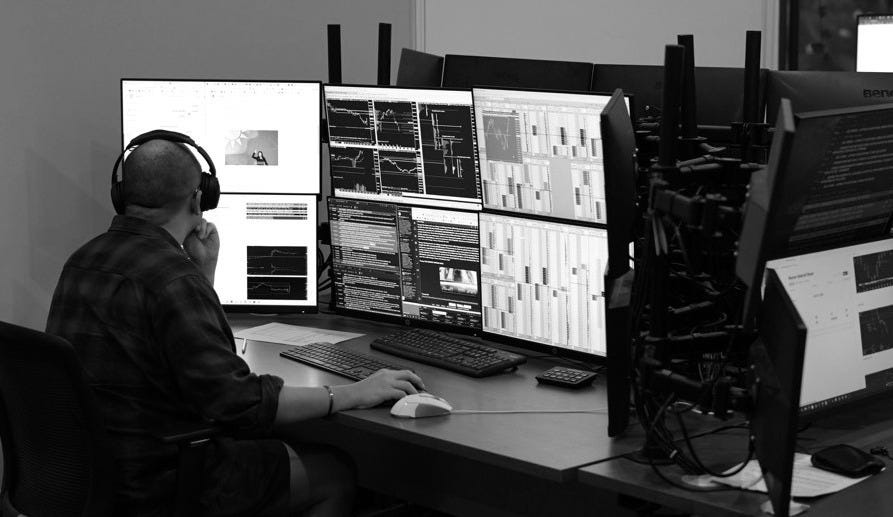
This photograph was taken by Asymmetrist on AXIA’s Cyprus trading floor and is used with the kind permission of Axia Futures. Photograph © Asymmetrist; all AXIA trademarks and logos remain the property of Axia Trading Group.
Disclaimer: Do Not Do Stupid Financial Decisions. This Is Not A Game.


Fantastic writeup on how H2 rewarded discipline over volume. The distinction between juniors needing pirhana-mode survival and seniors requiring patience is something I saw play out last quarter but never articulated this well. One thing that caught me off guard was how fast I went from confidently taking trades in high-volatility periods to second-guessing everthing when the regime shifted. The Voyager's storry about narrowing focus and rebuilding his desk layout is such a tangible reminder that environment shapes performance more than willpower.
Equities slowly melting up after this https://x.com/KobeissiLetter/status/2003526679709508005?s=20 . And it makes me wonder if, under Trump ironically, we get such a controlled environment + super low interest rates, that volatility in equities evaporates.