
A Market of Islands
A Trading Firm’s H2 2025 Review: Part I

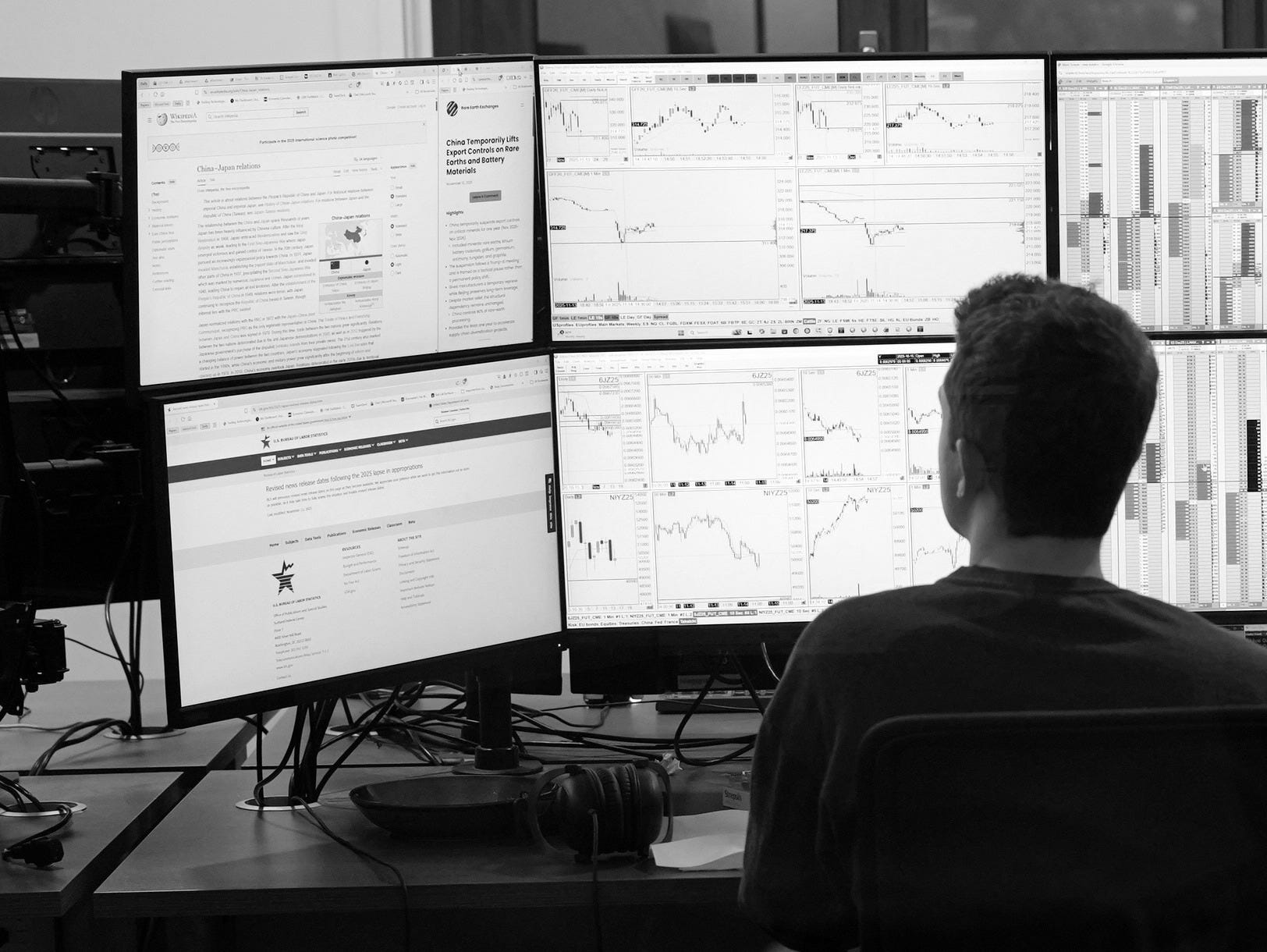
Across the AXIA trading desks.
July–December 2025.
London (England) · Limassol (Cyprus) · Split & Zagreb (Croatia)
The latter half of 2025 came bearing three gifts, though whether they are received as such is up to the trader. For many, these last six months were difficult to navigate. For some, tremendously so, coming off the high of H1’s performance. This is “casualty season,” as AXIA’s Alex Haywood called it: of young traders sustained by persistent volatility in H1, which allowed once great learners to quickly transform into performers, yet rendered them poor learners once they had to transition to H2’s sparse environment. In effect, they ‘solved’ H1, making them fragile for the dramatic change that followed. Yet at all levels, it is deadly for a trader to confuse present and future, and H2 showed how fast opportunity density can degrade until it shatters the nature of the game for those who have only been around long enough to experience but one instance.
Yet these months still brought gifts.
The first: a compression of time, reminding senior traders of the lifecycle of opportunity and allowing junior traders to experience it far sooner than usual, for their long-term benefit. These last six months were the death throes of the first six. The dense opportunities tradeable across nearly the entire skill spectrum, coupled with sustained high volatility, gave way to the opposite: low density, fragmented opportunities, and impotent spikes in volatility since the summer. If H1 was a test of Sitzfleisch—work capacity, physical stamina and mental alertness to face long hours and heavy news flow—H2 was a test of the near moral-spiritual; of morale and temperament. Do you believe? Do you really want this? To realise how abnormal H1 was and come back to the grind. As one trader put it, one endures the ‘normal’ placid times to reap the exceptional, abnormal slivers of opportunity. To force the trader to ask one of the most important diagnostic questions: has this period of fight brought out your best? The best bring out their best. For some, it has. For others, it has brought out their subsequent flight. This fragility is often masked when opportunity is fast and abundant. So too are traders blunted in highly opportune environments yet only sharpened in scarcity. The best reap the former, yet tangibly improve in the latter.
The second: a litmus test of defensive mastery. As The Warrior put it in Traders of Our Time, it’s about what you keep, not what you make. So spoke one of the most attack-favouring traders who is ever more remarkable for his ability to consolidate gains than for his explosive trading nature. H2 completed the whole three-phased nature of theme development: the shock, the peak, and the fade—the last separating those who mastered their news-macro-headline trading from those who hitched a ride on the faster, relatively easier opportunities of phases one and two. Such was the Trump-Tariff Redux story of 2025. For those who’ve both monetised and learned the nature of trading headlines and themes for the first time yet have given back a good part of these gains, it is worth remembering a truism: the trader is always made in the next cycle. If this describes you, dear reader, then you leave this year with two things: a bigger account, more size, and a wider repertoire of experience to hit the next news-headline-theme cycle smarter and sharper—this time with the third phase in mind, and with preservation as an explicit part of navigating the next cycle.
The third: to force traders to expand their adjacent possible. Rarely is the trader inclined to do so when the market rewards singular behaviour or a single framework. Reinforcement leads to over-optimisation and therefore fragility when the environment brutally changes. That is the story of H2—and, as a senior trader in London reminded Asymmetrist recently, one we had already been warning about in July’s Q2 2025 Review, and again as far back as January 2025: the Trump-Tariff gravity would fade, as all themes do, and performance would have to change with it.
For experienced traders: consolidate strong gains from earlier in the year, consciously forgo some mainstay opportunities, and accept what may seem like high opportunity costs in doing so. You can afford to reinvest attention and focus now to develop whatever lies on the horizon of your adjacent possible. How can you recombine your current skills to absorb and apply them to something new? A marker of mastery—the always-viable trader—is to increase one’s baseline opportunity density by doing the work. That is always under one’s control—not sustained, general volatility that feeds all traders.
For new traders facing different career imperatives, focusing on being the minimum viable trader (MVT) creates a fundamentally different problem than for a senior trader. It may well—and has done for junior traders observed at the desks—undo most, if not all, of the gains monetised in H1. In the long run, this is still a gift, because that is what the MVT must do: scramble to eat the lowest-hanging fruit, monetise—perform—then go back to being a learner and search for other fruit as the old spoils. The more reps one has crossing the antagonisms of learning and performing, the easier it becomes. Never having done so can spell absolute disaster later in a career.
Even in a low-opportunity-density environment with placid volatility, opportunity is ever-present—just not lifting all boats at once. It migrates between clusters, though this is harder to see when one is knee-deep in the thick of things. Such has been the performance story for the AXIA team in H2 2025: hotspots of intense yet brief P&L harvesting, only for the prime opportunity to shift to another group, focused with a different approach to markets. The rest have to endure the grind with flat P&L until they can quickly harvest another bout of fleeting opportunity, as is usual. Or, in some cases, access new opportunities by doing the work and expanding their ability to monetise it through new skills. If there is something close to a ‘normal’ market and trader performance state, this is close to it.
Spotting this requires a bird’s-eye view: teams of teams, not a small group reinforcing each other’s assumptions about what is possible. That’s what this review aims to achieve—and what a trader must do to expand their adjacent possible, to access these lone clusters of volatility. Often, it is enough to know that there are others who are having their best months in an environment that appears devoid of opportunity. To realise that it is only devoid of your opportunities. As per The Collector from Traders: “When you are struggling, all you need to know is that it can be done.”
Before we move into detail, one motif to consider, placed right at the start of Traders: “Pray for hard times first so you learn how to survive until the good times come. Because the reverse can be fatal.” 2025 gave the good times first. For those who had their first major career breakthrough or younger traders who graduated to live accounts, this creates a precarious foundation. Many can now prove this statement true if they don’t use H2 as a gift, a chance to learn how to survive or consolidate. Consolidation is a marker of mastery; learning how to survive is the kernel of longevity.
From Landmass To Island
A H2 2025 storyboard: the Trump-Tariff theme that erupted with Liberation Day in April had, by summer, entered phase three—the fade. The story was priced; attention moved on, only to resurface violently yet briefly in October when Trump threatened 100% tariffs in retaliation for China’s rare earth restrictions, before resolving in the Busan deal with Xi by month’s end. By November, the narrative centre of gravity shifted toward central banks—short-end curve moves, Fed comments, the slow data thaw after the forty-three-day shutdown ended. August was dry. September proved curiously technical, as AXIA’s Richard Bailey noted—especially in the S&P—yet culminated in rate moves once the Fed delivered its first twenty-five basis point cut mid-month, and another the following month. October brought the shutdown, the brinkmanship, then relief.
One can write a far longer list of vignettes and still arrive at the same point: the environment shifted from pervasive volatility to episodic. Scheduled headline injections, sentiment-driven flows like November’s AI overvaluation fears, short-lived ideas that never coalesced into themes. The trader required a whack-a-mole approach. For example: July brought Copper tariffs—isolated, but opportunity for those whacking. October saw France’s PM quit after under a month, following the prior PM’s ousting over budget gridlock; OAT-Bund spreads spiked back toward August crisis levels; bank stocks offered—yet this fiscal story failed to cascade into sustainable flow in OATs, or wider European markets. The UK budget in November offered a brief trade on £22bn of fiscal headroom before fading into chop. Late November’s Ukraine-Russia peace reports moved the Crude Oils—another slow-burner, choppy.
As Bailey observed, opportunity was actually scheduled much of the time—an October Fed meeting, Fed member comments throughout, data releases once the shutdown void was answered. Or the Reserve Bank of New Zealand’s November rate cut wrapped in hawkish guidance that surprised. This is migration from ambient to discrete opportunity rather than its complete absence. Side-lined themes—Trump-China, Russia-Ukraine—now require shocking escalation or de-escalation to reignite. Context shapes magnitude. And, as AXIA’s Eric Jousse noted: H2’s volatility would have been fantastic compared to far drier periods in the recent past. We suffer only relative to where we’ve come from. Traders adjust far slower on the fragmentation of opportunity and a volatility crunch than the reverse. In H2, opportunities simply dispersed as if a landmass giving way to small islands.
The Baseline, and the Exception
AXIA’s team-wide performance in H2 has been sound—though it can only ever feel good enough after such an explosive Q2. In a fragmented opportunity set, it’s a real result nonetheless. Seniors broadly kept building P&L, but at a slower pace. When they bemoan difficulty, that is what they mean—not account or career destruction. Some traders sat through deeper drawdown, yet the first half of the year made up for it. Younger ones suffered most—that is casualty season. Yet the firm, over the past two quarters, finished well into the eight-figure range, building on early 2025’s gains and locking in a benchmark year.
But there is an exception. And that is where the most interesting stories begin. Traders with the skill-set lineage of The Razor and The Voyager—and a junior who broke out in October–November’s metals and equity volatility—found opportunity density moving into their cluster, allowing The Voyager his best month since 2020. We will examine more in Part II.
That is to say: in any community, exceptional performances that disprove the rule—“it’s hard”, “it can’t be done”—are too easily ignored as anomalies, to the practitioner’s detriment. Yet younger traders, or those wishing to expand their adjacent possible, need a social sixth sense: to keep asking the young Collector’s eternal question—where are you making money? Not how. Learning from these specific traders who were anomalous because they over-performed in an environment it was seemingly deemed impossible were, in a sense, the best opportunity of the season: a live signal of where the fruit had migrated, and therefore the fastest way to iterate the cycle from learner to performer. Every community has theirs. The only question is whether you noticed, and if you did, who were yours?
What H2 Selected For
Bailey also noticed the inverse performance of The Engineer and The Godfather throughout parts of H2—a barometer worth examining. The Engineer operates chiefly within an overt technical framework, market profile as primary lens. The Godfather instead frames his trading consciousness around narrative, themes and news flow. In persistent volatility environments, both trade and both profit; the distinction blurs, as opportunity is dense across markets. Yet September was flat for news-driven traders while those with a technical framework like The Engineer performed. At certain stages of H2, the dominant approach of engaging with the market, and monetising your participation shifted dramatically week to week.
Meanwhile, the likes of The Voyager and The Razor saw opportunity density increase within very specific niches: metals, equities, their particular manner of trading. Not market-wide volatility—localised volatility. Consider what The Collector said in Traders:
“And remember, over the course of the year, someone is making money, as there is always an edge somewhere. It might just not fall in your specific niche. Almost a whole year can go by with barely any news comments. So … you’re sitting there waiting … just to hear a comment in 2014, yet for six months, there was barely anything. But then look at 2020, there were ten a week; it always comes and goes. However, in 2014, there were still opportunities if you were willing to learn new ideas and new strategies.”
Looking at the traders behind these markets—the group as a whole—reveals another critical distinction. Headline-driven volatility favours immediate execution; price and reaction alone determine success, and it’s one of the closest states where adverse selection is at its most clear. If offside, there is a good reason; if onside, there is also a good reason for it. So act accordingly.
But that same framework, using the headline and market reaction to validate market selection, trade management, and evaluating your performance, can’t be easily transplanted into sentiment-driven volatility. Often it is detrimental. This other type of volatility, like the emergence of the AI overvaluation narrative, is more meandering and less tangible. Then it disappears all the same. It requires an alternative framework, perhaps a lattice of multiple ones, to manage risk and conviction: market structure based, profile based, something beyond the trade idea itself. Adverse selection is blurred in sentiment driven, slower, less explosive markets:When, if ever, are you really wrong on the trade? When, if ever, are you really right on the trade? A headline answers that quickly, yet emergent flow seemingly from nowhere can never really answer that question for the trader. They need another explicit framework to answer that question, whatever that might be.
That is to say, H2 has rewarded both the multi-dimensional trader—those with different frameworks to deploy to navigate disparate opportunities, and the experience to fuse them into something uniquely theirs. For example: The Student, combining profile, market structure, narrative, and news trading. H2 also rewarded the niche trader, like The Voyager or The Razor. It simply needed the market to fall within their niche—on their island—and the opportunities became abundant and dense within that context. Compared to the general opportunities afforded by wide market volatility—Q2 2025 especially—this was a different world. For those outside these narrower domains, the problems of attempting to access opportunity are different for both senior and junior traders.
And that makes clear a specific kind of failure that mostly shows itself in scarcity: generalised failure. A trader who is not specialised—niche enough—to catch the islands, and not yet multi-framework enough to move between them and monetise them lucidly, defaults to a general engagement with the markets precisely when volatility is fleeting and opportunity density is low. Often they over-engage, still framed by the volatility and opportunities of the bygone H1. When opportunity disperses into islands, the trader who swims between them risks missing both: eroding energy, focus, and P&L on substandard engagement, only to arrive dulled when the rare, core yet fleeting opportunity finally presents itself.
This is where learning and performance take on a different flavour within scarcity, with different effects depending on where one stands in the career arc—junior traders are punished much more by getting it wrong, senior traders are punished much more by missing the opportunity. Part II will explore these mechanics directly: the cost of generalised failure.
Next Quarter: Suggestions for The Practitioner
I. Your island map
Where, specifically, did opportunity cluster for you in H2 and where did it vanish?
What did the opportunity landscape look like in your own world across H1 and H2? (This will differ if you trade, for example, single cash equities versus multi-asset futures, but the point is the same: what paid, when, and why?)
If the AXIA team is a baseline (very strong Q1 relative to 2024, explosive Q2, then tapering yet consistent Q3–Q4), how did your year match with that or diverge?
If opportunity migrated between clusters across your team, network, or community: whose cluster did you actually study in real time, and whose did you ignore?
II. Stamina, temperament, and test
Did you feel you were able to train your work capacity—Sitzfleisch—or stamina in H1?
Do you feel that H2 stretched you and made you better as a trader? Or did you shy away from it. If so, why was this the case?
Has this period of fight brought out your best? (Not as judgement, but as diagnosis.) If it brought out your worst: what was most affected, and is there any root cause? How can you structure things in 2026 to alleviate this?
III. Career stage lens (MVT vs AVT)
Make sure you first understand the difference between a minimum viable trader and an always viable trader. (Read here.)
Deeply understand whether you are a minimum viable trader—and where you are in your career—because what was “right” or “wrong” behaviour in H2 depends on your career stage, your runway, and your objectives.
Identify where you are in your career and what your objectives are. Ask plainly: did your actions this year actually fit those objectives?
IV. Framework recognition (headline vs sentiment)
In H2, when volatility appeared, did you correctly identify what kind it was: headline-driven or sentiment-driven, or something else?
If the technical Engineer and the news-driven Godfather are baselines on two ends of the edge spectrum, where did you sit relative to them?
V. Defensive mastery
What did you keep in H2—not just money, but confidence, clarity, and risk budget?
If you actively monetised trading headlines in H1, were you able to consolidate this in H2?
If not, what does that tell you about your headline trading in Phase 3. And what would you do differently if we get another cycle in 2026?
Which part of your risk-taking got cleaner in scarcity. And which part got noisier?
VI. The adjacent possible
What did H2 reveal to be just outside your current competence—the edge of your world?
What is one recombination of skills you could build that would raise your baseline opportunity density (something under your control)?
If you had to pick one “adjacent” market/structure/execution mode to work on before the next cycle, what would it be, and why?
Have you taken the opportunity in H2 to identify those who were live signals of the low-hanging fruit in the market, even when it wasn’t yours?
Did you try to expand your adjacent possible by locating them, learning where they were making money, and then figuring out your own how?
VII. Social sixth sense
Who, in your environment, was the live signal of where low-hanging fruit had migrated? And did you ask the only question that matters: Where are you making money?
When you were struggling, did you at least keep contact with proof that “it can be done,” or did you isolate and spiral?

Acknowledgements, Permissions & Disclaimer
Grateful acknowledgement to AXIA for granting access to many of their traders and their desks. Special thanks to Alex Haywood, Eric Jousse, Richard Bailey, and Mario Kyriacou for their time, candour, and ideas—some quoted directly, others woven into the fabric of this piece. Any errors or interpretations remain my own.
This photograph was taken by Asymmetrist on AXIA’s Cyprus trading floor and is used with the kind permission of Axia Futures. Photograph © Asymmetrist; all AXIA trademarks and logos remain the property of Axia Trading Group.
Disclaimer: Do Not Do Stupid Financial Decisions. This Is Not A Game.
One of the more interesting edges in 2025, to me, was BTC/NQ correlation. Feels like a derived DXY play with irrationally exhuburant metals adding obtuse pressure in strange places.
Blessings for the new year!
Cheers