


Dear Practitioners,
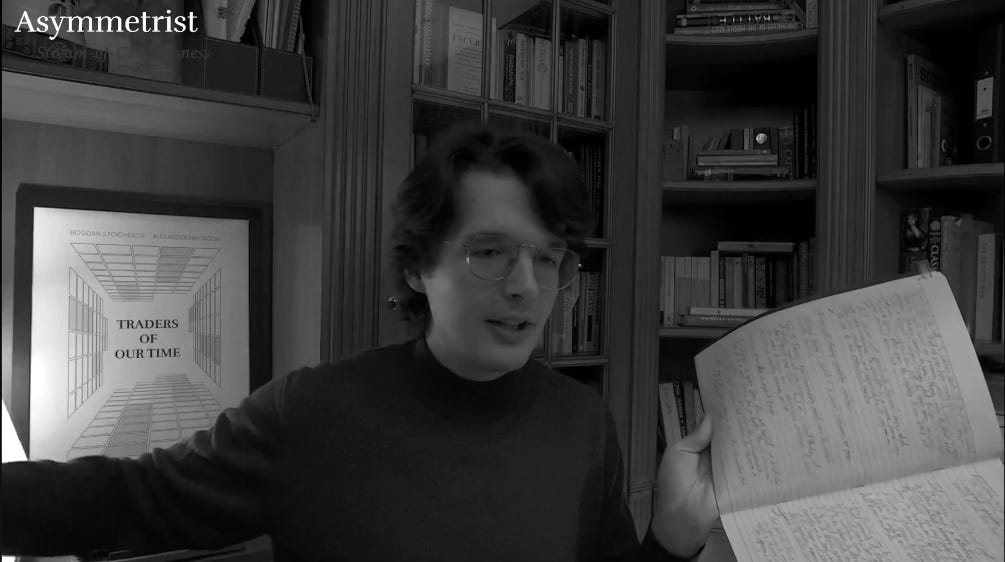
Stream of Consciousness returns on Saturday, 14 March at 6pm GMT, with The Warrior—Part II.
Spring is here and with it have come several intense trading weeks amid the ongoing Iran–US–Israel conflict, redux. As it pains me to acknowledge—never forgetting the real-world tragedies unfolding across the Middle East—this environment does place us in an interesting position to apply The Warrior chapters, and in particular Part II, as we continue our reading of Traders of Our Time.
You’ll also receive a reminder and link again once we go live.
For those who missed, or would like to rewatch, Part I of The Warrior, you can find the previous Stream of Consciousness here:

Ahead of the stream
In the spirit of the book club, you’re invited to read or reread Chapter 6 (The Warrior, Part II) beforehand.
If anything stands out, I strongly encourage you to add your thoughts, marginalia, or questions in advance in the chapter thread below.
This matters more than it might seem.
When reflections arrive ahead of time, I’m able to sit with them, trace patterns across responses, and bring them into the live session with more depth. The stream then becomes a continuation of the conversation, rather than a separate event.
Of course, you’re equally welcome to arrive fresh and take part live.
Chapter discussion thread & reflections:
If you’d like a starting point, here is a set of optional prompts. You do not need to answer everything. One question is more than enough.
You can share your reflections in the comments below, or in the book-club chat thread set aside for this chapter. Chapter 6 Thread Link, once more.
Core themes of Chapter 6
From the chapter itself, the major ideas are:
Narrative thinking in markets
World-building and scenario planning
Emotional and physical preparation for risk
Conviction at narrative turning points
Creativity as the human trader’s edge
I. Rereading with distance
If you’ve reread this chapter, what do you see now that you didn’t the first time? In particular, how does it read after last year’s markets and the opening of this January?
When you first read The Warrior, what did you think the chapter was trying to show? On rereading, what do you think it is really about?
Does having finished Traders of Our Time change how you read this chapter? Which later traders or ideas quietly reappear once you look back?
Is there a moment, sentence, or scene that carries more weight now than it did before? Why this one, and why now?
II. Narrative and world-building
The Warrior mentally constructs multiple possible futures before an event. Do you recognise this type of preparation in your own trading or decision-making?
What advantages might come from thinking about markets as stories or unfolding narratives rather than just data?
Do you think narrative thinking is a strength or a risk for traders?
III. Visualising the moment
The Warrior imagines the exact moment of execution: headlines, correlations, price ladders, position size.
Have you ever mentally rehearsed a market scenario like this before it happened?
What might be the benefits — or dangers — of this kind of preparation?
Does visualisation increase conviction, or can it create bias?
IV. The “plot twist” moment
The chapter suggests markets have moments where the narrative suddenly shifts.
How do you recognise these turning points in real time?
Do you believe these moments occur frequently, or only a handful of times each year?
How do traders miss them?
V. Belief, narrative, and meaning
One of the striking ideas in the chapter is that The Warrior does not necessarily out-think others—he out-believes them.
What do you think that means in practice?
Is belief something that can be developed, or does it come only from experience?
Where is the line between conviction and overconfidence?
VI. Memory and experience
The Warrior recalls past market contexts in extraordinary detail.
Why might contextual memory be such an important trading skill?
How does remembering past market “worlds” help interpret the present one?
Have you experienced a moment where an old market memory suddenly became useful again?
VII. Creativity as edge
The chapter argues that creativity may be the lasting edge for human traders.
What does creativity in trading actually look like?
How does creativity differ from simply reacting to information?
Can systematic approaches capture the same kind of edge?
VIII. Final reflection
After reading this chapter:
What do you think is the real lesson of The Warrior?
What part of his mindset feels most transferable to your own development and what part does not?
These sessions are intentionally exploratory and slow—hence Stream of Consciousness. I’ve placed them outside the trading week, and outside the usual pressure to extract conclusions too quickly.
Some people join every time; others dip in and out as needed. Both are entirely fine.
Let’s continue with The Warrior, Part II!
Good trading to you all,
Bogdan