


The Idea INDEX
Node 005. (This Entry May Evolve)
First Published: 02.12.2025
This is a public work in progress.
An evolving index of links, notes, observations, and narrative fragments left to incubate, accumulate, and sometimes collide. The Idea Index Explained Here.
There’s value here already, though incomplete. These entries may connect with past or future Asymmetrist pieces or remain spare parts, waiting. This node will evolve.
Take what you like. Please share, fork, reject, and build on it. However, please attribute it.
But most of all: collaborate with me! Comment below or write directly: bogdan@asymmetrist.com
Eventually, enough of these nodes will emerge into something more.
There is an intricate, looped relationship between time and uncertainty. Time shapes the nature of uncertainty, influencing the emergence of behaviour, volatility, and the digestion of information. Does the passage of time increase or reduce uncertainty? Does uncertainty undulate as time offers an opportunity to reduce it through information gathering, or does it decay altogether with respect to that particular question the market is trying to answer?
And there is another entangled phenomenon within markets: volatility. Markets have one foot in the linear progression of time, yet they also operate in their own special, warped world where ‘market time’ can violently twist non-linearly. High-volatility periods can reprice an entire distribution of outcomes in days that might have taken months before—only for that repricing to be redone in hours once again.
Between time, uncertainty and volatility, there are also expectations … and expectations of expectations! It is as if one were attempting to drive by looking into the rear-view mirror, only to look at another mirror facing forward towards the windscreen, reflecting a distorted road ahead. All with varying degrees of certainty about uncertainty.
Options markets have attempted to formalise parts of this relationship—sometimes disastrously so—yet the more profound implications remain under-examined, especially for discretionary outright (directional) trading. The role of time is more elusive still, though no less decisive.
Consider The Hero from Traders of Our Time:
“Are there any new things you are discovering about the market profile?”
“Yes—understanding time as a mechanism, as a validator or invalidator of ideas.”
So we’ve come to the area between trade ideation and application, the area where the trader must navigate alone in real time without guidance—a marker of both mastery and talent.
Time is implicit in everything the trader does, so implicit that it rarely receives direct examination. In every sense, we trade time. We trade the uncertainty entangled with it, the narratives that require it, and the recursive, reflexive behaviour of markets that depends on it. Contrary to the tidy abstractions of mainstream finance, nothing is priced instantaneously in practice. Themes need time to form; narratives need time to mature; consensus needs time to dissolve and reassemble. Time is at play somewhere between perception and repricing, inhabiting the gap between what we think the market should do and what it actually chooses to do. From The Sphinx’s chapter in Traders:
“The markets do not instantly price in the entire future, because our ability to act on the markets is a linear and finite process. The physical act of buying and selling tethers an abstract, tangled market hierarchy to the real world, as it cannot violate the linear progression of time.”
This is why ‘procedural expertise’—step-by-step rules, checklists, static formulas—struggles to account for the entangled, time-bound nature of uncertainty as it is actually experienced in markets. Procedural tools tend to flatten time, treating it as if it does not exist; perceptual expertise by contrast—the cultivated ability to see, to observe—naturally works within this implicit ambiguity.
What, then, truly counts as a resource for a discretionary futures trader? Liquidity, volatility, P&L—yes, the usual suspects—and perhaps your own human energy and attention are some of those usually named. But time is the oft-overlooked fifth. The first four are measured, budgeted, or at least monitored; the fifth is mostly assumed. Time is both a resource and an implacable force.
Time as Opportunity Cost
Every trade carries an attritional cost, though it is rarely explicitly acknowledged. Being in a trade consumes attention, narrows one’s field of vision, and occupies time that could have been spent elsewhere. A profitable trade still proves costly when measured against better opportunities it displaced. Much of a trader’s frustration comes from this misallocation, the sense that something better was unfolding elsewhere while attention remained occupied.
Consider The Razor’s chapter from Traders:
“Fifth principle: To click is human; to refrain, divine. Trading action bears a hidden cost; successful trading offsets it, but the bad exacerbates it. Active trading drains energy and focus—a trader’s ability to spot the forest for the trees is slowly chipped away. Trading outside of worthwhile edge depletes the trader before the real action appears. ”
The trader’s P&L should consider gains minus the attrition of time. Commissions and round-trips are visible; the opportunity cost of time is not. A trade held too long, even a good one, may represent a misallocation of a limited resource.
“If we are victorious in one more battle with the Romans, we shall be utterly ruined.” So spoke the Greek Pyrrhus of Epirus.1 It’s just too costly to win! Worse still when the cost is not immediately realised but remains an invisible force: a series of winning trades that ruins you over time, because the true victory would have been to be in a different place at a different time. A pyrrhic profit.
This extends across trading styles. Some traders spend time gathering, digesting, observing, as The Razor does, expanding imaginative bandwidth and deepening pattern recognition. Others spend that same time in constant action, gathering a different form of information. And then there are the small temporal windows that provide genuine tactical advantage: responding quickly to a headline and capturing several prices ahead. The narrowness of time as a window of opportunity becomes a barrier to entry for many other participants, allowing those who can act within it a degree of differentiation that forms part of that nebulous term, “edge”.
Time as Information
Time can also help a trade by revealing information most acutely available to those actually managing a position. That is what it means to navigate, to possess trade sense: to be receptive to a stream of feedback that cannot be experienced in quite the same way from the sidelines. You learn not only through observation but through active exploration. In other words, a decision-maker in a complex environment must gather information by participating in the environment. As the Cynefin framework puts it for the complex domain: probe–sense–respond.
A similar principle appears in cognitive science: Bayesian learning can accelerate when information is actively sampled. You learn by acting, not merely by watching. A trader in a live position absorbs a kind of information that simply does not exist in passivity: order-flow clues and cues; small relationships and behaviours across markets, often intangible, yet capable of producing meaningful second-order effects that only become visible to the active trader.
Yet this must not collapse into the belief that more time automatically yields better information. In complex environments, the pursuit of complete data is a mistake. High-quality, timely, and incomplete information is what matters; completeness arrives only in hindsight, when it can no longer help. Given enough time, even the “complete” picture can decay as the underlying environment shifts.
The trader must stop information-gathering once the information is “good enough”, not once it is perfect. Decisions must be made with partial visibility because complete visibility belongs only to the past. Judgement is therefore a central skill: the ability to choose with incomplete inputs, to see possible futures rather than wait for certain ones. That is, to choose the right time.
Time as Pressure and Attrition
Time asserts itself most visibly in moments of compression. The sudden, volatile, meaningful headline is the brief window in which to hit markets. These moments strain the body—days compressed into hours.
But time also shapes the opposite state: long stretches of inactivity, where time feels dilated. Here, the trader confronts a paradox of performance psychology: boredom, under-stimulation, and uncertain waiting can be more stressful than acute events. In quiet markets, the body is unprepared for action precisely because nothing has yet required it. H1 2025 felt like a physical occupation, demanding constant readiness; H2 felt like a slow erosion of morale, psychological and spiritual conviction. Quiet markets do not break traders all at once; they hollow them gradually.
AXIA’s Alex Haywood has often framed this as a question of whether one can use time in their favour rather than merely endure it. During the early 2025 action, he asked, in effect, whether you could compress recovery time by deliberate intervention: a cold plunge between sessions, a short but targeted gym routine, any practice that restores the body faster than idle waiting would. In other words, can one manipulate the effects of time at the level of physiology so that the body is ready?
Time and Entropy
Time is also taxation, and so is every unexamined hour spent in front of the screens. The trader must constantly fight this drift, maintaining clarity amid gradual deterioration. The Engineer once mentioned how he explicitly fights “style drift” in his approach as time passes.
Markets themselves evolve. New behaviours emerge, old phenomena lose relevance, regimes shift, and previously dominant metagame becomes obsolete. Consider market relationships and correlations pre-COVID and now.
Emergence is central here: one of the defining characteristics of complex systems is that the whole exhibits properties that cannot be reduced to the sum of its parts. New behaviours, new edges, and new failure modes appear not from individual components but from their interactions—interactions that require time to accumulate, scale, and change again.
The same is true for traders. A trader’s ability is rarely reducible to isolated skills; it is an emergent property built through time, through repetition, through the accumulation of tacit knowledge, and through the slow interplay of many imperfect components that somehow aggregate into something coherent.
Seen this way, a trader’s “edge” over long periods is less a single pattern or method and more an unusual tolerance for entropy: an ability to remain functional, curious, and precise. It demands something like a mission of Permanent Revolution in one’s own practice.
Time, therefore, becomes not only a source of decay but also the medium through which new patterns and abilities emerge. The interplay between entropy and emergence is central to market navigation.
Time, Talent, and Trade Sense
Talent and skill in trading are not delivered all at once. They condense over time: the slow aggregation of many imperfect components exposed to enough market time to cohere. Navigating order flow; managing positions; regulating one’s own physiology; sensing when a theme is exhausted; knowing when not to trade at all—each ability on its own is incomplete. What matters is how they interact, break, and re-form as experience accumulates.
Consider The Engineer’s examined S&P trade in Traders of Our Time:
“There was nothing particularly special about the lead-up to the trade on 18 September that would suggest the kind of P&L The Engineer was about to make. He hoped, perhaps, to make only what was now average—a $100,000–$200,000 trade—if he could get away a hundred lots before the market slipped lower. Yet, by the end of the day, our trader would haul in $900,000 and offload some eight hundred lots into the S&P. What was the difference, then, between standard and masterstroke? Trade sense.”
“Trade sense” is not a single faculty but a property that emerges from time spent deliberately navigating the markets. To say that someone has trade sense is often to say that they navigate time unusually well. They know when a trade is still alive and when the idea has expired, even if the current market action has not yet made this clear. This is what The Hero was pointing to when he spoke of “time as a mechanism, as a validator or invalidator of ideas”—trade sense as temporal judgement.
More than trade sense—it was masterful navigation of time validating an emergent idea. He had seen enough, learned enough, and sat through enough imperfect attempts that his sense of timing, scale, and durability had changed. The trade grew larger because he had grown into it, and that growth was itself a product of time.
In this sense, the highest expression of trade sense is the capacity to navigate time: to decide which ideas deserve more of it, which must be cut away quickly, and which can be allowed to expand into something larger than they first appeared.
Time and Career Creativity
Trading is a creative act, though it is seldom described as such. Creativity benefits from both constraint and gestation. A short temporal window can force inventive solutions; a longer observational phase can allow ideas to sublimate and reorganise. Time governs both modes.
One cannot simply remove the role of time in internalising the behaviour of a complex environment. Just as a musician cannot compress years of developing tonal memory into a few weeks, a trader cannot bypass the slow accretion of tacit understanding, pattern recognition, narrative digestion, and an entire web of evolving connections. Practice and feedback can accelerate this process, but they cannot abolish it. Complexity resists being fully mastered at speed; it has to be lived through.
For traders like The Engineer, understanding time as a resource becomes central: time allows for the digestion of market behaviour, the slow construction of a coherent internal model, and the emergence of opportunities that align with one’s strengths. Creativity in trading is not a single moment of inspiration but a long process of taking in, digesting, recombining, and acting. Time enables this, even as it constrains it.
One of the most effective ways to capture the benefits of time as a resource is through reflective capacity—most visibly, through a journal. The Student in Traders of Our Time used his journal to stretch experience out in time: to let sessions settle, to pause, to think about what he was doing, and to see patterns that live trading alone could not reveal. As we wrote in the book, the journal is a way of navigating the antagonism between action and reflection.
That tension—between doing and thinking about the doing—is part of the long-term process of creativity in trading. Over years, it becomes one of the determinants of career longevity, growth, and direction. It is also one of the more reliable ways to move towards becoming an ‘Always Viable Trader’.
Time as a Metagame Driver
Time also drives the metagame. Over time, market participants learn from one another, absorb each other’s tactics, and attempt to outmanoeuvre one another. The very act of answering the market’s question changes the question.
Plutarch records a law attributed to the Spartan lawgiver Lycurgus: his countrymen should not make war often, or for long, with the same enemy, lest they train that enemy in their art of war.2 That is the metagame in miniature: respond to a once-dominant approach often enough and you begin to dismantle it. Traders cannot help but alter the market they trade; the market cannot help but change the trader responding to it. This relationship is shaped above all by time.
This is also where participation becomes unavoidable. Markets can only be navigated, not solved. The trader must operate inside the system to understand it, because understanding in practice arises from participation. To attempt to stand outside the market is to remove oneself from the very feedback loops through which judgement, skill, and metagame navigation are formed. Navigation is an emergent competence, a skill set that develops primarily through time spent within the system’s unfolding behaviour.
Time, therefore, is the metagame’s engine: the force through which adaptation accumulates, edges decay, behaviours spread, counter-behaviours emerge, and entirely new opportunities surface because the old ones have been seen, studied, copied, or defended against.
It is also why the book is titled as it is: Traders of Our Time. We trade in time, through time, and against time.
Comment below to help expand Node 005 into something greater!

Adapted from Plutarch, Life of Pyrrhus in Parallel Lives. The familiar English phrasing “If we are victorious in one more battle with the Romans, we shall be utterly ruined” is a widely used modern paraphrase of Pyrrhus’s remark after Asculum. For the full story, see public-domain translations in the Dryden tradition (e.g. http://classics.mit.edu/Plutarch/pyrrhus.html).
Paraphrased from Plutarch, Moralia: “Laconic Apophthegms”, §213f, in The Morals, ed. and trans. William W. Goodwin (1878), public-domain text as reproduced in ToposText: https://topostext.org/work/266
Acknowledgements:
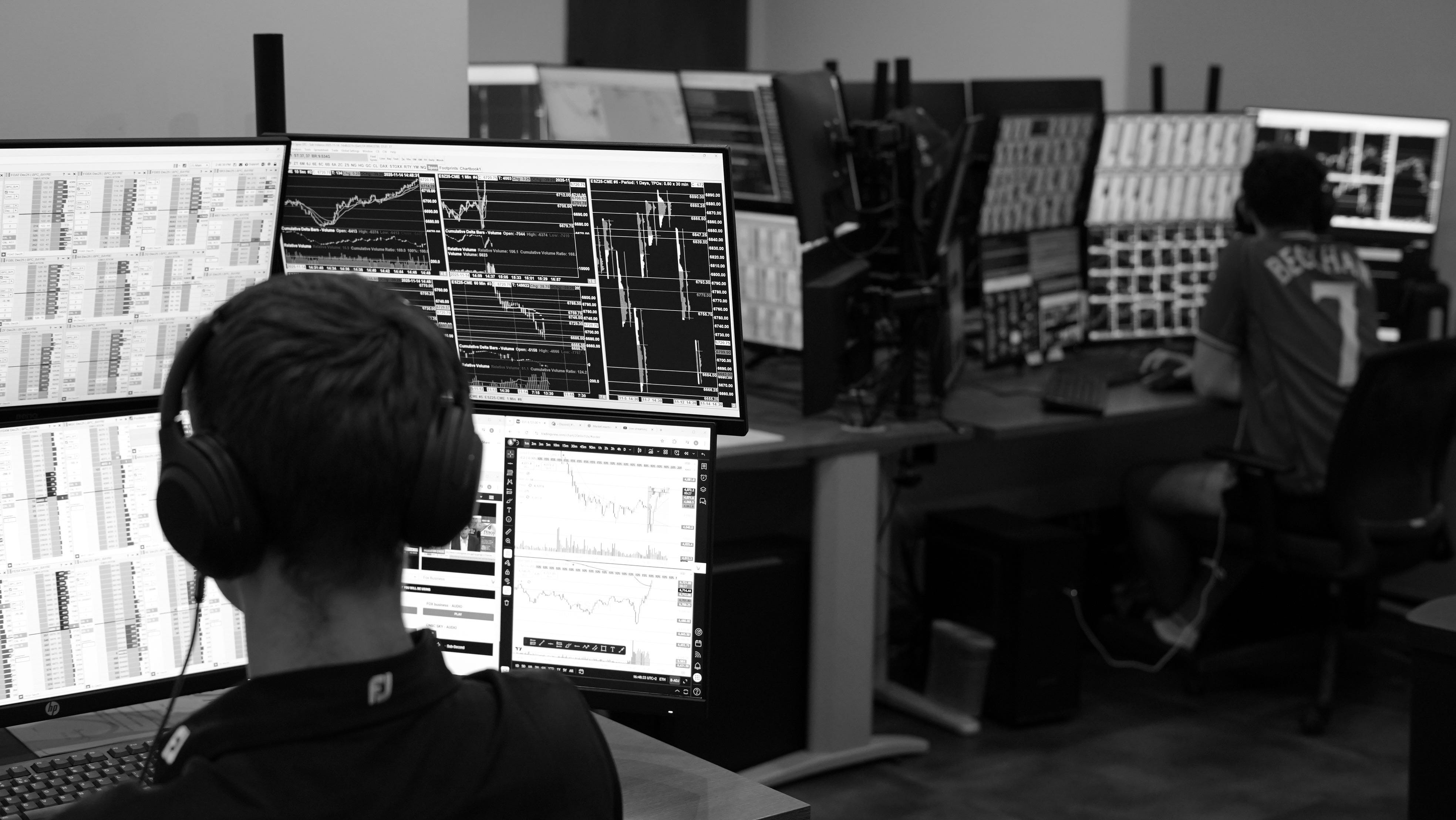
This photograph was taken by Asymmetrist on AXIA’s Cyprus trading floor and is used with the kind permission of Axia Futures. Photograph © Asymmetrist; all AXIA trademarks and logos remain the property of Axia Trading Group.