


Dear Practitioners,
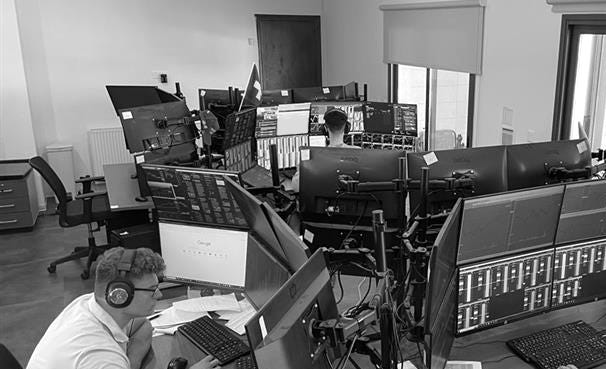
Since the beginning of May, I have been using my writer-in-residence role on AXIA’s Cyprus floor: speaking with traders up and down the career curve, observing the desk, revisiting recent market episodes, and gathering the small remarks, questions and fragments that allow certain dots to be reconnected. Sometimes they rearticulate old principles in new ways. Sometimes they bring something half-forgotten back into focus. And when they become useful beyond the person or conversation from which they emerged, they ought to be shared.
The notes below come from that cross-section. Some will be familiar. Some may put words to something you have already felt but not yet articulated. Others may only become useful later, when the market presents the right problem. That is often how these things work. One sentence, if it arrives at the right moment, can alter the way a trader sees an entire situation.
The timing also matters. We are within a more mature phase of the Iran War theme. The first fever of repricing has passed; the market is no longer responding with the same freshness to every headline; and, unless the theme re-accelerates into something more violent, traders may again find themselves in that awkward middle state: waiting for new information, trying to price what is already known, and gradually discovering that the previous operating mode no longer fits the current environment.
That kind of transition is never merely a market condition. It is a trader-development problem. When volatility compresses, when the dominant narrative begins to tire, when the market moves from trading on headlines to trading between them, the usual painful transition begins. Those who have seen enough of these cycles recognise it sooner. Those who have not may mistake the change in tempo for the disappearance of opportunity itself.
At the very least, the past few years have made the existence of these cycles easier to justify. Their compression has become visible. A decade ago, when the rate of change was slower and the intervals between regimes longer, the younger trader had far more reason to doubt that the monster of change did in fact exist. Only the true novice, who has seen little, or the ideologically entrenched, who refuse to see, can doubt it.
Last week’s quarterly review tried to diagnose the broader shape of the year so far. What follows is more immediate and practical: field notes, in effect — a working list of principles, fragments, provocations and reminders drawn from the floor. Read it as field material. Take what is useful. Test it quickly. If one line opens something up for you, follow it all the way.
And if any of this speaks directly to what you are navigating now, comment below. I may fold the strongest responses into a future Living Library episode.
Good trading to you all,
Bogdan
Unlock Source, Depth and Sense
Asymmetrist is read by traders across the career curve for exclusive stories, career-design thinking, and upstream sense making in markets.
The work exists for practitioners serious about developing careers rather than merely chasing individual trades, and for those who understand the near-incalculable long-term return of placing oneself in the right informational and developmental environment over time.
Join below for full subscriber access to:
exclusive training-floor stories like trading the current Iran War, The Warrior trading January’s Greenland de-escalation, a team navigating Trump tariffs,
long-form Features like The Counterintuitive Shape of Trader Development or When Tools Become the World.
brand new initiatives for 2026: The Living Library—applying all that is published against current market conditions, from navigating markets pricing between headlines to understanding where to place oneself with strategic advantage.
Observation Before Strategy
What is implicit to all successful market navigation is the primacy of observation over strategy. Observation is the least reductive of all processes. The further one moves away from observation, the more one’s trading decays. ‘Strategy’, in the way of an articulable plan—read: ‘setup’, ‘play’—is a useful tool for efficient communication, but not navigation. Communication is not navigation. Strategy is often the residue of past observation, compressed into language after the fact. Useful, even necessary, but already one step removed from the living market that produced it.
Yet everyone wants strategy and few want to observe. Strategy is indicative of an environment that has been stable long enough to be ‘solved’, which means it is either crowded, dominated by your local neighbourhood server rack, or about to expire. The future belongs to the next environment, in which intuition based on observation can succeed.
Strategy, in its least corrupted and most useful form, is a way of higher-level orientation and not a mechanical list of prescribed tools.