


Dear Practitioners,
This is the moment we have been building toward since January—now arriving, just in time, as February closes and we step into March.
Across these parts, we began with observation. We returned to first principles. We traced the category error. We examined how tools distort perception, how distortion hardens into identity, and how identity quietly shapes careers. What began as a technical confusion revealed itself as a deep career flaw.
For now, I regard this series as foundational. It should stand as canonical reading for anyone attempting to construct frameworks beyond news and headline reaction—for those building what is often called “technical” trading—and for those who wish to avoid the failures that begin with confusing the tool for the market. It is equally for the young graduate entering the arena and for the senior practitioner seeking expansion beyond inherited limits.
Asymmetrist is read by traders across the career curve: on professional desks, aspiring to join them, and operating independently. This piece is valid for all of you.
This part formally concludes the series. Next week, however, I will publish a smaller experimental companion—something designed to work hard at distilling and organising the core ideas into formats that are easier to review, revisit, and apply—across text, visual, and more. If it proves useful, it may become a standing practice—a way to support the canonical long-form work with structured digestion and iteration.
That will close the first publication cycle of 2026. After that, we will move into something entirely different for Cycle Two.
Until then,
Good reading and good trading to you all,
Bogdan
Unlock Source Depth and Sense
Asymmetrist is read by traders across the career curve for exclusive stories, career-design thinking, and upstream sensemaking in markets.
This is paid work for serious practitioners who understand the near-incalculable return on developing careers rather than chasing individual trades.
Join below for full subscriber access to:
exclusive training-floor stories like The Warrior trading January’s Greenland de-escalation, a team navigating Trump tariffs, and the recent déjà vu of the US–Iran–Israel conflict in 2025.
long-form Features like this series, and earlier ones like The Counterintuitive Shape of Trader Development
brand new initiatives for 2026: The Living Library—applying all that is published against current market conditions, from navigating markets pricing between headlines to understanding where to place oneself with strategic advantage.
Want to (Re)Read the Earlier Parts?
Note: The series, When Tools Become the World, builds cumulatively and assumes the reader is up to date. If needed, revisit the previous parts below:
Positions:
The future pays; the past explains.
Representation records; expectation reprices.
Identity defended becomes opportunity forfeited.
Good money is earned at the frontier of expectation.
The practitioner of tomorrow dissolves boundaries before markets do.
Part IV(b): Trading What Is About to Matter
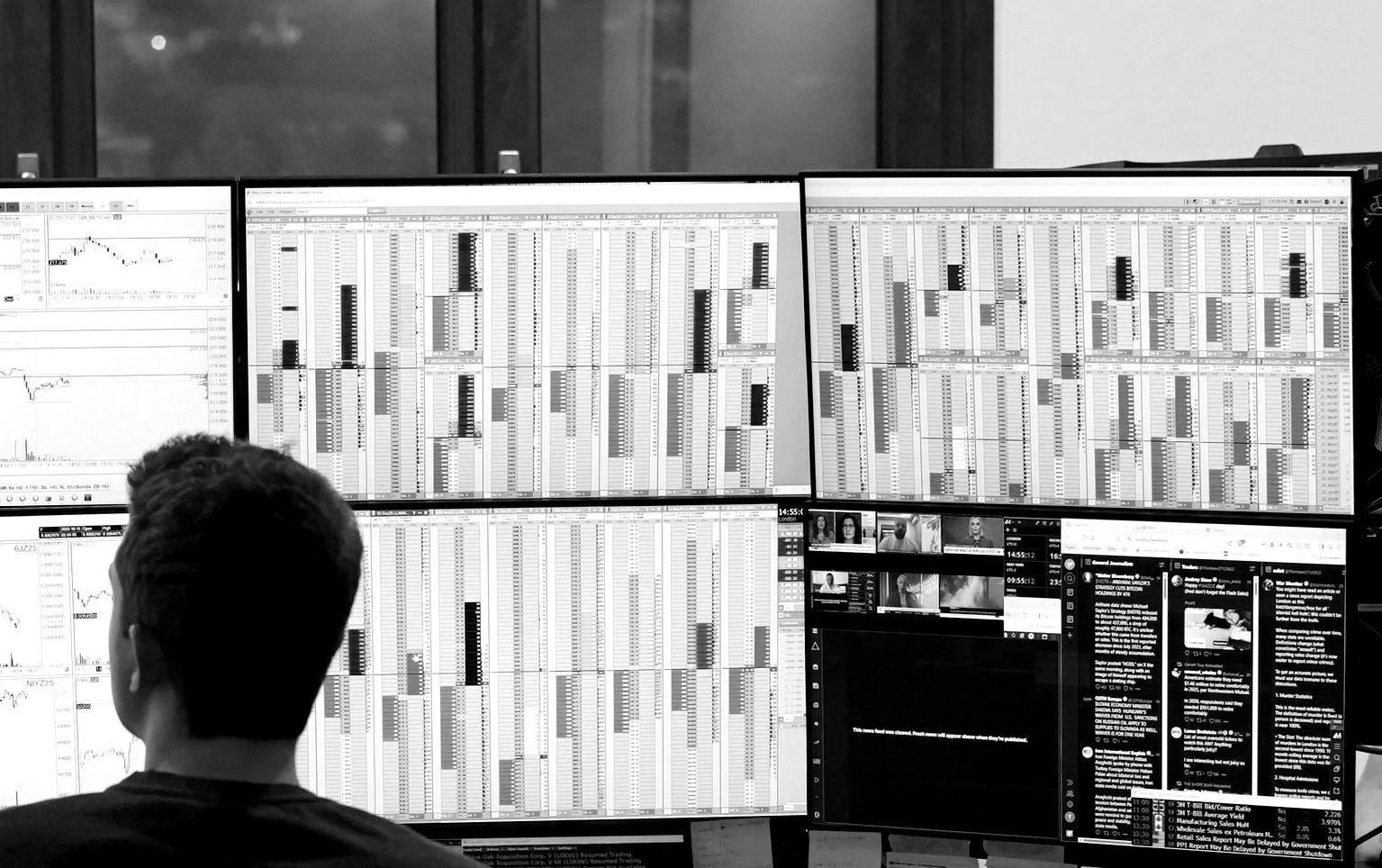
We ended Part IV(a) with the diagnostic question: If you remove the tool, do you still have your trader?
Yesterday’s impromptu Living Library captured this situation in action. The timing of the 28 February Iran–US–Israel escalation—culminating in the killing of Supreme Leader Khamenei, with headlines swinging between confirmation and disconfirmation of the closure of the Strait of Hormuz, and sporadic Iranian retaliation against other Gulf states—fell into a weekend, when futures markets were shut and no data or action could be made legible and printed onto screens.
Representation was removed. Tools—which so often generate failure states—were absent. There were no charts, indicators, or patterns to infiltrate “strategy” and reduce the trader to a lever-puller of the past, dictating binary actions. There was only the forward problem: possibilities, multitudes, expectation. In effect, the trader was placed exactly where monetisation actually lives—The Singularity of Now.
The irreducible moment in time where future states of the world meet the present and collapse into the irrefutable past. It forced the trader to look forward and continuously judge how expectations might shift as events unfolded. No one could fall into the well-trained groove of looking backwards at their tools. Judgement could not be outsourced. One foot had to remain in the present while observing the future and trading as the two met. You know the truth when you see it.
Anyone who felt lost without their tools this weekend must return to the diagnostic: if you remove the tool, do you still have your trader? If you felt you had no charts to tell you what to do, that is precisely the problem in your trading.